DETERMINANTS OF KNOWLEDGE OF DEPRESSION AND SUICIDAL IDEATION AMONG POSTPARTUM WOMEN IN BENIN CITY BENIN CITY, EDO STATE
Formerly published in Vol. 6, No. 1, Jan. - Jun., 2021
Keywords:
Postpartum depression, suicidal ideation, postnatal, knowledgeAbstract
Background: Postpartum depression is a global health challenge that negatively affects pregnancy outcomes. This study assessed the knowledge and determinants of depression and suicidal ideation among postpartum women.
Method: This is a questionnaire-based cross-sectional study which was carried out among 480 nursing mothers attending the postnatal clinics at the University of Benin Teaching Hospital selected by systematic random sampling technique. Pretested self-administered semi structured questionnaire was utilised for the study. Data was analysed using the Statistical Package for Social Sciences (SPSS) version 25.0
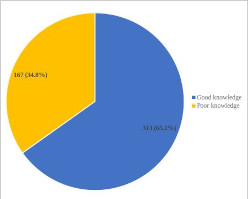
Result: The mean age of respondents studied was 31.3 ± 5.7 years. All respondent 480 (100.0%) and 354 (73.7) heard of the term depression and suicidal ideation respectively. Up to 313 (65.2%) respondents had good knowledge of postpartum depression and suicidal ideation while 167 (34.8%) had poor knowledge. It was further identified that religion (p=0.005), marriage type (p < 0.001), level of education (p < 0.001) and skill level (p < 0.001) were significant determinants of knowledge of postpartum depression and suicidal ideation among respondents studied.
Conclusion: An estimated two-third of respondents studied had good knowledge of PPD and suicidal ideation. There is need to include health education sessions on postpartum depression and suicidal ideation during antenatal and post-natal clinic sessions in health facilities.
Downloads
References
1. Stewart DE, Robertson E, Dennis CL, GraceSL, and Wallington T.: Literature review of risk factors and interventions on Postpartum Depression. Department of Mental Health and Substance Abuse. Geneva: WHO. 2008.
2. Barber JS, East PL. Home and parenting resources available to siblings depending on their birth intention status. Child Development. 2009; 80(3): 921 – 939. DOI: 10.1111/j.1467-8624.2009.01306. x.
3. Afolayan J, Onasoga OA, Rejuaro FM, Yusuf AG. Knowledge of Postpartum Depression and its Associated Risk Factors Among Nurse-Midwives in a Nigerian Tertiary Hospital. Sierra Leone Journal of Biomedical Research. 2016; 8(2):54. DOI:10.4314/sljbr.v8i2.7. Accessed on 22nd May, 2023.
4. Ukaegbe CI, Iteke OC, Bakare MO, Agbata AT. Postpartum Depression Among Igbo Women In An Urban Mission Hospital, South East Nigeria. Ebonyi Medical Journal. 2012; 11(1&2):29 – 36. Available at https://www.ajol.info/index.php/ebomed/article/view/86281. Accessed on 22nd May, 2023.
5. Population City. Edo–Population. 2015. Available at http://population.city/nigeria/adm/edo/. Accessed on 11thNovember, 2022.
6. University of Benin Teaching Hospital, UBTH, Nigeria. 2021. Available from: http://www.ubth.org. Accessed on 11thNovember, 2022.
7. Cochran WG. Sampling Techniques. Third Edition. New York: John Wiley & Sons, Inc.1977:149-156
8. Obioha EG, Balogun MR, Olubodun T, Okafor I. Knowledge, Attitude and Prevalence of Postpartum Depression among Postnatal Mothers in Southwest Nigeria. African Journal of Health Sciences, 2021; 34(6): pp. 779 – 792. Available at https://www.ajol.info/index.php/ajhs/article/view/220555. Accessed on 22nd May, 2023.
9. World Health Organization. The Global Health Observatory - Women of reproductive age (15-49 years) population (thousands). 2023. Available at https://www.who.int/data/gho/indicator-metadata-registry/imr-details/women-of-reproductive-age-(15-49-years)-population-(thousands). Accessed on 6th May, 2023.
10. Agbaje OS, Anyanwu JI, Umoke PIC, Iwuagwu TE, Iweama CN, Ozoemena EL, Nnaji IR. Depressive and anxiety symptoms and associated factors among postnatal women in Enugu-North Senatorial District, South-East Nigeria: A cross-sectional Study. Archives of Public Health, 2019; 77(1). Doi: https://doi.org/10.1186/s13690-018-0329-6.
11. Adeyemo EO, Oluwole EO, Kanma-Okafor OJ, Izuka OM, Odeyemi KA. Prevalence and predictors of postpartum depression among postnatal women in Lagos, Nigeria. African Health Sciences, 2020; 20(4): 1943 – 1945. Doi: 10.4314/ahs. v20i4.53.
12. Statista.
a. Total Employment in Nigeria 2020, by Age Group. Statista. 2022. Available at http://statista.com/statistcs/1288451/total-employment-in-nigeria-by-age-group/. Accessed 18th November, 2022.
b. Literacy Rate in Nigeria 2018, by Zone and Gender. Statista. 2022. Available at http://statista.com/statistcs/1124745/literacy-rate-in-nigera-by-zone-and-gender/. Accessed 18th November, 2022.
13. Grech J, Calleja N, Grech J. Pregnant women's awareness, knowledge, and attitudes about Perinatal depression. Mental Health and Prevention, 2022; 26(391). Doi: 10.1016/j.mhp.2022.200238.
14. Tobiloba AI, Omotayo AP, Sodeinde K, Akinyemi A, and Chichebem NB. Knowledge, Attitude and Prevalence of Postpartum Depression Among Mothers Attending Immunization Clinics in Osogbo Local Government, Osun State. African Journal of Health, Nursing and Midwifery, 2022; 5(4):. 28 – 42. Doi: 10.52589/AJHNM-UI5DYZVX.
15. World Health Organization. Suicide. Fact Sheet No398. [accessed 15/06/2024];2024 http://www.who.int/mediacentre/factsheets/fs398/en/
16. Zhao J, Yang X, Xiao R, Zhang X, Aguilera D, Zhao J. Belief system, meaningfulness, and psychopathology associated with suicidality among Chinese college students: a cross-sectional survey. BMC Public Health. 2012; 12:668.
17. Huguelet P, Mohr S, Jung V, Gillieron C, Brandt PY, Borras L. Effect of religion on suicide attempts in outpatients with schizophrenia or schizoaffective disorders compared with inpatients with non-psychotic disorders. European Psychiatry: the journal of the Association of European Psychiatrists. 2007;22(3):188–194.
18. Obioha EG, Balogun MR, Olubodun T, Okafor I. Knowledge, Attitude and Prevalence of Postpartum Depression among Postnatal Mothers in Southwest Nigeria. African Journal of Health Sciences, 2021; 34(6): 779 – 792.
19. Jongkind M, van den Brink B, Schaap-Jonker H, van der Velde N, Braam AW. Dimensions of Religion Associated with Suicide Attempt and Suicide Ideation in Depressed, Religiously Affiliated Patients. Suicide Life Threat Behav. 2019 Apr;49(2):505-519. doi: 10.1111/sltb.12456. Epub 2018 Apr 20. PMID: 29676507.
20. Li C, Wei Z, Wang Y, Sun L. Associations between Suicidal Ideation and Relatives' Physical and Mental Health among Community Residents: Differences between Family Members and Lineal Consanguinity. Int J Environ Res Public Health. 2022;19(23):15997. Published 2022 Nov 30. doi:10.3390/ijerph192315997
21. Doi S., Fujiwara T., Isumi A. Association between maternal adverse childhood experiences and mental health problems in offspring: An intergenerational study. Dev. Psychopathol. 2021;33:1041–1058. doi: 10.1017/S0954579420000334. [PubMed] [CrossRef] [Google Scholar] [Ref list]
22. Bright AM, Doody O, Tuohy T. Women with perinatal suicidal ideation-A scoping review of the biopsychosocial risk factors to inform health service provision and research. PLoS One. 2022;17(9):e0274862. Published 2022 Sep 28. doi:10.1371/journal.pone.0274862
23. Lawrence RE, Brent D, Mann JJ, Burke AK, Grunebaum MF, Galfalvy HC, Oquendo MA. Religion as a Risk Factor for Suicide Attempt and Suicide Ideation Among Depressed Patients. J Nerv Ment Dis. 2016 Nov;204(11):845-850. doi: 10.1097/NMD.0000000000000484. PMID: 26894320; PMCID: PMC4990512.